Chapter 3 of 7 · The equipment queue
The equipment queue: transformer and switchgear makers are building to keep the wait, not to end it
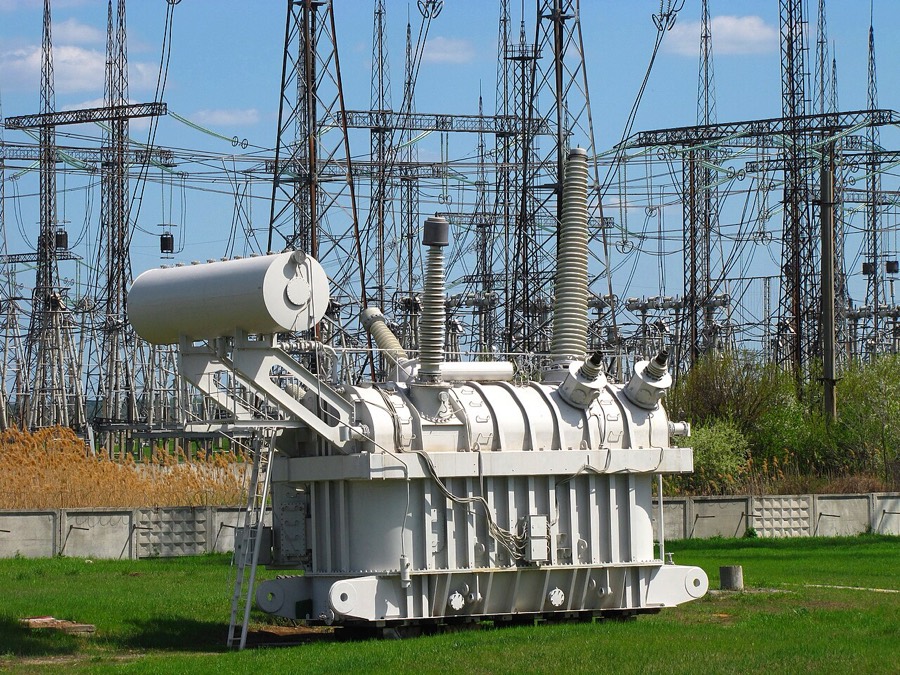
Hitachi Energy, the grid business of Japan’s Hitachi, is building or expanding more than 40 factories to make the heavy electrical gear that AI data centres need. At its investor day in June 2026 it told investors what it expects when they open: a pile of signed orders still worth two and a half to three years of sales.
Siemens Energy tells the same story from Germany. It has added factory space and is spending more than €2bn on more, and its grid business now carries about four years of signed work, up from three and a half when the building began.
That is the claim of this piece. The makers of transformers and switchgear are building fast enough to keep the queue, not to clear it, and on their own figures the queue will still hold years of work in 2030. A data centre’s real start date is set by that queue, often before the site is chosen.
The analogy
A popular hairdresser takes forty minutes over a cut: that is the build time. Ring her today and the first free slot is weeks away: that is the lead time. Her diary, full for weeks ahead, is the years of work: the reason the slot is so far off.
She adds a second chair only once the bookings justify it, so the diary still runs weeks ahead. She also remembers the year the salon down the road added four chairs and closed. Her chairs tell you she is growing; her diary tells you when you get a cut. For grid gear, the diary runs in years.
What electrical gear does an AI data centre need before it can switch on?
A chain of five or six separate machines, each from its own factory, that steps the grid’s voltage down and protects every step from faults.
Power arrives at a large campus at transmission voltage, often 115 to 345 kilovolts (kV), thousands of volts. A server runs on a few dozen volts. Between the two sit the machines this piece is about.
Between the grid and the chip sit five or six machines, each from its own factory, each with its own queue
The electrical chain into an AI campus, simplified, not to scale
First comes a substation, a fenced yard where the grid’s line ends. In it sit high-voltage circuit breakers, giant switches that open within hundredths of a second on a fault, and power transformers, which step the voltage down to medium voltage. Next comes medium-voltage switchgear, a row of steel cabinets full of breakers that routes power to each hall. Smaller transformers then step down to low voltage, and inside each hall come low-voltage switchgear, a UPS (an uninterruptible power supply, bridging a grid fault on batteries) and backup generators.
The site switches on only when the last one arrives. The slowest of them, by years, is the large power transformer at the front of the chain.
What does a transformer actually do, and why can’t a data centre buy one off the shelf?
Grid power is alternating current, which reverses direction 60 times a second in America and 50 in Europe and most of Asia. A transformer changes its voltage with two copper coils on a shared steel core, and nearly every large one is designed for one site and built to order.
A transformer is steel, copper and oil with no moving parts, and every part has its own supplier
A large power transformer cut open, simplified, not to scale
The ratio of turns in the two coils sets the ratio of voltages. The US Department of Energy estimates that about 90 per cent of the electricity Americans use passes through at least one large power transformer, a unit rated at 100 MVA or more. An MVA, a megavolt-ampere, measures how much power the unit can carry; for this gear it reads close to megawatts.
A large unit is mostly steel, copper and oil, with no moving parts beyond its tap changer, which adjusts the ratio a little. Tall insulated plugs called bushings carry each conductor through the tank wall.
The department’s 2012 study calls these units “custom-designed equipment”, each engineered for one substation. An industry source told it that only about 1.3 units are built to each design. Utilities also buy only from makers they have prequalified, by auditing the factory, which the department calls “a lengthy process that can take years”. So there is no shelf stock and no spot market. A campus joins the order book of a maker its utility already trusts, and waits its turn.
The wait hides three clocks. Build time is how long one transformer spends in the factory: months, not years. Lead time is how long a buyer waits from order to delivery. Years of work is how far ahead a maker’s signed orders run at its current pace. Headlines quote the second. This piece is mostly about the third, which keeps the second long.
Why is the steel in the core so hard to get?
Because it is a special grade, and America has one mill that makes it.
Grain-oriented electrical steel, or GOES, is rolled and heat-treated so its crystals line up, which makes the core waste far less power as heat. The Department of Energy’s report to Congress of July 2024 names Cleveland-Cliffs as “the sole active domestic GOES supplier”. On data from 2020 to 2022, that mill could meet only 12 to 20 per cent of American demand, and the highest grade comes only from Nippon Steel in Japan. About 80 per cent of GOES used in America in 2019 was imported in some form.
More is coming, slowly: on 5 October 2026 Cleveland-Cliffs announced a $200m project to lift its output by up to 25 per cent by early 2028. Even then one mill would remain a minority supplier.
Where do the months go in the factory?
Into a few fixed stations, each needing skilled hands, a clean hall and heavy cranes, which a maker cannot multiply quickly.
The core is stacked from thousands of thin steel sheets by hand, work the department says “requires highly-skilled work force”. The copper is wound around it, the assembly is dried in ovens, fitted in a clean hall and tested at high voltage. The 2012 study put the time to make one large unit at “in excess of six months”. The binding constraint is not the hours but the stations: winding lines, drying ovens, crane bays and test bays. The 2024 report says capacity “cannot easily be expanded except by building a new facility”.
So a transformer that leaves the factory in months can still take years from order to switch-on, and most of that time is spent waiting for a slot at the stations.
How long is the wait, and how is it measured?
Years for a large unit, by every published measure, against months before the pandemic.
In 2010, the Department of Energy found, American makers delivered in five to 12 months from order. Its July 2024 report gives the new normal: “36-month lead times being commonly quoted and maximum lead times reaching as much as 60 months”. Before the pandemic a large unit could be ordered with a lead time of less than a year.
Wood Mackenzie, an energy research firm, put power transformers at 128 weeks on average in the second quarter of 2025, a consultant’s survey figure used here only as a cross-check. Smaller distribution transformers, which serve streets and buildings, have eased to about 30 weeks on its count. The large units, built on the scarce stations, have not followed.
How full are the makers’ order books?
Every maker of this gear that publishes a backlog has more years of work waiting than when its factory building began.
Backlog is the pile of signed orders not yet delivered. Book-to-bill is orders divided by sales in the same period; above 1, the pile is growing. Years of work is backlog divided by the previous four quarters’ sales, my arithmetic from each filing.
The wait is getting longer, and the new factories are still to come
Signed orders not yet delivered, in years of each business's sales
Hitachi Energy had $66.9bn of orders waiting at 30 September 2026, about 3.1 years of its sales, up from about 2.8 in March 2025. Siemens Energy’s grid business, Grid Technologies, had €51bn at 30 June 2026, about four years, up from 3.56 in September 2024. GE Vernova’s grid business, Electrification, had $42.2bn of equipment backlog at 30 September 2026, 60 per cent more than a year earlier, including $5bn from Prolec GE, the transformer maker it bought outright in February 2026.
Eaton is the inside-the-fence test. Its Electrical Americas business sells the switchgear and power rooms between the substation and the racks. Its backlog of $16.0bn at 30 September 2026 was 1.05 years of sales, up from 0.89 at the end of 2024, though flat since June 2026, the first sign that this queue may be levelling off.
The ratios are not comparable with each other, because the grid makers also carry HVDC links, high-voltage direct current lines that take years to build. The direction is the point: all of them rose in the same two years the factory programmes were announced.
Why don’t the makers build enough factories to clear the queue?
Because a factory lasts decades and one AI cycle may not, and the makers have said in their own words that they will not build ahead of signed orders.
At its investor day on 10 June 2026, Hitachi showed its energy backlog growing towards about $100bn by fiscal 2030, and said it expected the backlog to “remain stable at 2.5-3x” revenue. Hitachi says it invests only in projects whose profitability is secured. ABB, the Swiss maker of switchgear and power gear, said in October 2026 its capital spending will stay “around $1 billion”, with new capacity partly from “selectively leveraging third-party assembly”: borrowed floor space, which can be handed back.
There are three reasons. A transformer hall runs for decades, and an AI build-out that slows in 2029 would leave it idle for most of its life. The makers also remember the last boom, from 2008 to 2011, which ended with an anti-dumping order on Korean makers. And the queue pays: a long order book lets a maker choose its orders and price them.
When do the new factories arrive, and how much do they add?
Mostly from 2027, and greenfield plants take two to three years from announcement to first product.
Most of the new floor space lands from 2027 on
Dated plants for transformers, switchgear, bushings and core steel, from announcement to the production date given
The department says winding machines and core tables alone “can take 1-2 years to obtain from suppliers”. Eaton’s Jonesville plant in South Carolina, announced in February 2025, is due in 2027. Hitachi Energy’s Gallman plant in Mississippi, announced in September 2026, is due in 2029, and it replaces the nearby Crystal Springs plant, so the net gain is the difference.
The base is small. The Commerce Department’s 2020 survey found American plants could make about 343 large transformers a year, while 754 were needed in 2019. Of those, 617, or 82 per cent, were imported. America’s own halls would need to double just to meet 2019’s demand, before any AI campus.
What does Siemens Energy’s own chart say about the shortage?
That demand for large transformers in Europe and North America runs ahead of every maker’s capacity in every year to 2030, by a narrowing margin.
At its capital market day on 20 November 2025, Siemens Energy set regional demand for large and medium power transformers against the capacity of all makers. It is the only published estimate of the gap from a maker itself.
Siemens Energy's own forecast: the shortage narrows, but never closes
Demand for large and medium power transformers above the capacity of all makers, Europe and North America
Demand ran about 40 per cent ahead of capacity in fiscal 2025. By fiscal 2030 the gap narrows to about 10 per cent, as capacity nearly doubles from fiscal 2023, by my reading of the chart’s bars. Every year that demand exceeds output, the shortfall joins the pile.
The number the claim rests on is Siemens Energy’s grid ratio: €51bn of signed, undelivered orders at 30 June 2026, divided by €12.9bn of Grid Technologies revenue over the previous four quarters. The backlog is rounded to the nearest billion, so the true ratio lies between 3.92 and 4.00; the claim records it as 3.96. It is not a quoted lead time, because the HVDC links lift it, so the direction matters more than the level.
The trap is that the ratio can fall while the pile grows. Siemens Energy’s grid revenue is growing about 25 per cent a year on its own guidance. At that pace the ratio holds only if orders run about 1.8 times sales; at the third quarter’s 1.48 it would fall to about 3.4 by mid-2028, while each year’s shortfall still joins the pile.
Where do America’s large transformers come from?
Mostly from abroad, and increasingly from Korea, while China supplies little.
America's imports of large transformers more than tripled in three years, and China supplies little
US imports of liquid-filled transformers above 10 MVA, by value
United Nations trade data show American imports of liquid-filled transformers above 10 MVA rising from $1.26bn in 2022 to $4.15bn in 2025, 3.3 times in three years. Mexico was the largest supplier in 2025, at 19 per cent, and Korea’s share rose from 7 to 18 per cent. China supplied 2.2 per cent by value in 2025. The average unit imported in 2025 cost about $0.83m, so this customs line is dominated by mid-sized units, not only the very largest.
The queue in America is filled by imports from makers who also serve their home grids, so a boom in Europe or Asia can lengthen the American wait. The new American halls replace imports as much as they add supply.
What do tariffs and the emergency order change?
They raise the cost of the steel and parts more than the finished unit, and they let the government shut out some foreign gear, which together tilt the queue toward a few makers.
Until 2028 the finished transformer is taxed less than the steel it is made from
US Section 232 tariff on the full value of the goods, since 6 April 2026
Under America’s Section 232 tariffs, imposed on national security grounds, large power transformers pay 15 per cent until 31 December 2027, then 25 per cent. The GOES strip itself, and copper wire, pay 50 per cent. So until the end of 2027 a finished unit pays a third as much as the steel it is built from. That favours importing whole units, or ready-made cores, over making cores from imported steel in a new American hall, and the rate on the finished unit rises just as the first new halls open.
On 26 August 2026 the President signed Executive Order 14421, declaring a national emergency over the bulk-power system, the high-voltage network. It lets the Department of Energy bar foreign-produced equipment, including transformers, breakers, UPS systems and backup generators, where it finds a link to a covered foreign entity and an undue risk. It is not a blanket ban, and no rule had been published by 7 November.
What are prices doing?
Rising again, faster than in 2023 and 2024, which is not what a market where the shortage is easing looks like.
Prices jumped in 2022, slowed, and are rising faster again
US producer price indexes, transformer and switchgear makers, 2020 average = 100
The Bureau of Labor Statistics’ producer price index for transformer makers averaged 255.3 in 2020. By September 2026 it was 475.1, 86 per cent higher, preliminary for the latest month. Prices jumped 34 per cent in 2021 and 18 per cent in 2022, then rose only about 4 per cent in 2023 and 2 per cent in 2024. In 2025 they rose 5 per cent, and in the year to September 2026 nearly 8 per cent. If the shortage were clearing, the index would flatten or fall. It has done the opposite.
Does the gear inside the fence queue too?
Yes, by a year or two rather than three or four, and the makers say so in their own words about when 2026’s orders will ship.
Inside the fence, this year's orders ship in one to three years
When orders signed now are due, in each maker's own words, from today
ABB told analysts in October 2026 that its data centre gear has lead times of 12 to 24 months, so this year’s orders ship in 2027 and 2028. Schneider Electric, the French maker of power and cooling gear, says its record backlog gives “visibility into 2027 and 2028”. Generators queue longest: Caterpillar told analysts it is accepting some large engine orders into 2029 and turbine orders into 2030.
Schneider also sells power rooms built in its own plants as modules. Prefabrication shortens the install, not the order book: the modules still need gear from the same queues.
AI racks change the low-voltage end far more than the grid end. A rack of Nvidia’s GB200 chips draws up to 132 kilowatts, about fifteen times the typical rack’s almost 9, and Nvidia plans racks of a megawatt from 2027.
An AI rack draws fifteen times the power of an average one, and Nvidia plans over a hundred times
Power drawn by one rack, kilowatts
A 100 MW campus needs the same substation, medium-voltage switchgear and generators whether it runs 11,000 racks at 9 kilowatts or 760 at 132. What changes is the gear nearest the rack: busways, power shelves and, from 2027, rectifiers and new direct-current breakers. That reshuffles the low-voltage order book; it does not shorten the grid-side queue.
Will the parts be the next queue?
Possibly: some bushings now wait longer than a whole transformer did before the pandemic, though other parts are flowing freely.
A transformer ships only when its slowest part arrives. Hitachi Energy publishes delivery times for the components it sells to other transformer makers. On 29 October 2026 it gave 135 weeks for its GSBK and ARF high-voltage bushings from Ludvika, Sweden; in 2012 the Department of Energy heard such bushings took up to five months. Tap changers, another bought-in part, are quoted at 10 to 22 weeks from Ludvika, so the strain is not everywhere.
A high-voltage bushing from Sweden now waits longer than a whole transformer did in 2010
Delivery times quoted for transformer parts, weeks
Two moves fit the reading that parts are binding. On 28 October 2026 GE Vernova agreed to pay about $9.0bn for Trench, which makes bushings, and called it “vertically integrating an existing supplier”. And Hitachi Energy is spending $106m at Alamo, Tennessee, on what it calls the “largest bushings manufacturing facility in North America”. The inference is mine, and it is a hypothesis: if parts gate output, a new hall adds floor space before it adds transformers. Swedish bushing waits falling below a year would kill it.
Has the shortage peaked?
The rate of increase probably has, but every order book is still growing, and a narrower gap still adds to the pile.
The case for a peak is real. Siemens Energy’s grid book-to-bill fell to 1.48 in the quarter to June 2026, from 2.28 in the quarter before. Eaton’s Electrical Americas ratio went flat. Wood Mackenzie’s estimate of the power transformer shortage fell from 30 per cent for 2025 to 15 per cent for 2026.
The case against is stronger. Every book-to-bill is still above 1, so every pile is still growing. GE Vernova’s grid equipment backlog is up 60 per cent in a year, or about 40 per cent without the Prolec GE purchase. Transformer prices are rising faster than in 2023 and 2024. A real peak shows up as price cuts and idle halls. Neither is visible yet.
Spares do not change this. Installing a ready spare takes three to four weeks, but spares exist to replace a failed unit at an existing substation, not to serve new load.
So who holds the scarce thing, and what should an investor watch?
Whoever owns the slowest station: the large transformer halls, the steel, and a few parts.
If the queue is kept, three positions gain. The grid makers: Hitachi Energy, Siemens Energy and GE Vernova, with HD Hyundai Electric, Hyosung and LS Electric from Korea, hold years of signed work and the choice of which orders to take. The inside-the-fence makers: Eaton, Schneider Electric, ABB, Siemens, Vertiv, Legrand, nVent, Hubbell and Powell make switchgear, UPS systems and power rooms, with a shorter queue. Caterpillar, Cummins, Generac and Rolls-Royce make the backup generators. The parts behind the parts: bushings, tap changers and core steel come from a few suppliers.
Four numbers carry the story. Siemens Energy’s grid ratio and Eaton’s Electrical Americas ratio each quarter, which are the claim’s tests. Book-to-bill at the grid makers, which shows whether the pile is still growing. And Hitachi Energy’s component delivery page, which shows whether the parts are easing.
A utility can clear a site’s place in the grid queue, as in America rations the plug, and the site still waits for its transformer. Nvidia launches a new flagship chip about every year, and a transformer ordered today joins a pile that would take three or four of those generations to clear. So a data centre’s real start date is set years before the chips it will run are on sale.
What would prove me wrong
Three tests can break the claim. The first is the ratio drifting down. If by 30 June 2028 Siemens Energy’s grid order book has fallen below 3.6 years of its sales, or Eaton’s Electrical Americas below one year, the first wave of new plants has shortened the queue and the claim fails. This test is closer than it looks: Siemens Energy’s grid sales grow about 25 per cent a year, so at the third quarter’s book-to-bill of 1.48 the ratio would reach about 3.4 by mid-2028. Orders must run about 1.8 times sales to hold it, and Eaton’s ratio has already gone flat.
The second is orders cooling as the plants open. If book-to-bill falls below 1 at the grid makers just as the 2027 halls start, the makers built into a slowdown. For now Siemens Energy’s grid business is at 1.48 and GE Vernova’s at about 1.4.
The third is someone breaking ranks. If makers outside this group, in Korea, Brazil or China, add capacity to clear the queue and American buyers accept their units, it empties faster. The Korean makers are adding capacity in Alabama and Tennessee; if they build ahead of orders, the wait shortens.
The claim stands on two legs. The first is time: halls take two to three years, and steel, ovens and test bays cap output, but that expires as the halls land from 2027. The second is choice: the makers size halls to signed orders, a business decision they can drop. The wait in 2030 rests on the second leg. Two things would not move me. More factory announcements: they are the headline, not the order book. And price rises: they show the queue holding, not clearing.
The claims on record, word for word
The equipment queue is kept, not cleared (30 October 2026)
Claim: “The first wave of new transformer and switchgear plants will not shorten the equipment queue in years of work: at 30 June 2028, Siemens Energy Grid Technologies’ order backlog will still be at least 3.6 times its revenue over the previous four quarters (3.96 at 30 June 2026), and Eaton Electrical Americas’ backlog at least 1.0 times its sales over the previous four quarters (1.05), even though Siemens Energy’s own chart allows its ratio to fall while the pile grows.”
Breaks if: “At 30 June 2028, as each company reports it, Siemens Energy Grid Technologies’ order backlog in euros divided by its revenue over the previous four quarters is below 3.6, or Eaton Electrical Americas’ backlog divided by its sales over the previous four quarters is below 1.0.”
Four earlier claims on this queue, word for word:
Schneider Electric sells AI data centres the finished system, not the parts (7 October 2026)
Claim: “Schneider Electric’s AI data centre growth is arriving as finished systems, built and tested in its factories, rather than as loose parts, because skilled hours on site are now scarcer than equipment, so Systems will keep taking a larger share of its revenue.”
Breaks if: “Systems falls below 34 per cent of Schneider’s group revenue, its 2025 level, for the full year 2026 or 2027 while Schneider describes Data Centre and Networks sales as growing double digit; or Products outgrows Systems on an organic basis for two quarters running while data centres remain Schneider’s main growth driver.”
Where later evidence bears on it: Not broken, but close. In the third quarter of 2026 Products grew 17% against 22% for Systems, and Schneider says Products growth was “majority volume-driven”: more loose parts, not just higher prices. The nine-month Systems share is about 34% from rounded shares (33.9% to 34.9%), on the line. The share test checks the outcome, not the cause: buyers may want prefabrication for speed as much as for scarce electricians.
Hitachi Energy is spending more than $9 billion on factories, and still plans a three-year queue (22 October 2026)
Claim: “Hitachi Energy is adding factories only as fast as signed orders justify, and its order backlog will stay at or above about 2.5 times annual revenue, roughly three years of work, through fiscal 2030, which ends on 31 March 2031, so the queue for its transformers and HVDC links will not clear.”
Breaks if: “Hitachi Energy’s order backlog divided by its revenue over the previous four quarters, both in US dollars as Hitachi reports them (about 3.06 at 30 June 2026), falls below 2.5 at two consecutive quarter ends before 31 March 2031, the end of fiscal 2030; or its orders for any full fiscal year up to fiscal 2030 fall below its revenue for that year.”
Where later evidence bears on it: Holding. The ratio rose to about 3.1 at 30 September 2026 (Hitachi, 28 October 2026). Hitachi Energy’s US programme is now around $1.5bn; its own releases give no date for the South Boston plant.
Eaton is shipping more electrical gear than ever, and its order book is growing faster still (26 October 2026)
Claim: “Eaton is shipping more electrical gear than ever, yet its Electrical Americas backlog keeps growing faster than its sales, so the queue for the equipment inside a data centre’s fence, measured in months of sales on order, will keep lengthening until its new plants arrive in 2027.”
Breaks if: “Electrical Americas backlog divided by the segment’s sales over the previous four quarters (1.05 at June 2026, up from 1.04 in March) falls for two consecutive quarters before mid 2027, when the new plants start; or falls below 0.93, its June 2025 level, before the end of 2027; or the segment’s twelve-month book-to-bill falls below 1.0 for two quarters running; or Electrical Americas margin is still falling year on year after Eaton reports price and cost back to neutral.”
Where later evidence bears on it: Holding, but flat. At 30 September 2026 the ratio was 1.050, against 1.049 in June (Form 10-Q, 3 November 2026). It has stopped rising but has not fallen; some of the earlier rise may be price. Twelve-month organic orders were up 39%. The margin, 29.8% in the third quarter, was still below the 30.3% of a year earlier.
Siemens Energy has measured the transformer shortage, and its own chart runs to 2030 (28 October 2026)
Claim: “By Siemens Energy’s own estimate, demand for large and medium power transformers in Europe and North America exceeds the combined capacity of all market players in the region in every year through its fiscal 2030, which ends on 30 September 2030, so unfilled orders keep accumulating even as the gap narrows: Grid Technologies’ orders stay above its revenue each fiscal year and its backlog in euros keeps growing.”
Breaks if: “Before 30 September 2030: Grid Technologies’ orders fall below its revenue for any full fiscal year; or its order backlog in euros, as Siemens Energy reports it (€51bn at 30 June 2026), falls for two consecutive quarters; or Siemens Energy publishes a revised estimate showing transformer capacity meeting demand in Europe and North America before fiscal 2030.”
Where later evidence bears on it: No new annual figures by 7 November 2026; fiscal 2026 results are due in November. Grid Technologies’ book-to-bill was 1.48 in the quarter to June 2026 and 1.88 over nine months, and its backlog rose to €51bn. Siemens Energy announced its Charlotte plant for early 2026; a Reuters report of 26 June 2025 relayed a board member giving early 2027, and its release of 3 February 2026 gives no date.
The figures behind the charts
What a transformer is. US Department of Energy, Large Power Transformers and the U.S. Electric Grid (June 2012): “custom-designed equipment”; about 1.3 units per design (industry source); core 80,000 to 120,000 kg in a 300 to 500 MVA unit; HV bushings “often have a long lead time extending up to five months”; seven build steps, core building “requires highly-skilled work force”, final assembly “in a clean environment; even a tiny amount of dust or moisture can deteriorate the performance”; “a long-lead time (in excess of six months) to manufacture”; prequalification “a lengthy process that can take years”; weights about 100 to 400 tons; most railcars about 100 tons; about 30 Schnabel cars in North America; lead times in 2010 of 5 to 12 months for US makers and 6 to 16 for foreign, citing the US International Trade Commission. US Department of Energy, Large Power Transformer Resilience, report to Congress (signed 10 July 2024): about 90% of US electricity passes through at least one large power transformer; 100 MVA definition; “36-month lead times being commonly quoted and maximum lead times reaching as much as 60 months”; pre-pandemic lead times under a year; capacity “cannot easily be expanded except by building a new facility”; new factory 1 to 3 years, winding machines and core tables “can take 1-2 years to obtain from suppliers”; route clearance up to nine months; “Only about three of these specialized transport cars are available in North America” (p. 19); GOES and copper “each account for roughly 25 percent of final LPT production costs” (Commerce, 2020); Cleveland-Cliffs “the sole active domestic GOES supplier”, meeting 12% to 20% of demand (2020 to 2022 data); top grade only from Nippon Steel; about 80% of GOES imported in 2019, all forms; “a major weak link”; 754 large transformers for US use in 2019, 617 (82%) imported; domestic maximum about 343 a year.
Years of work.
| Maker, business | Backlog | Revenue, previous four quarters | Years of work | Earlier point | Orders against revenue | Latest filing |
|---|---|---|---|---|---|---|
| Hitachi Energy | $66.9bn, 30 September 2026 | about $21.6bn | about 3.1 | about 2.8 (31 March 2025) | 1.66 times, fiscal 2025 | Hitachi results, 28 October 2026 |
| Siemens Energy, Grid Technologies | €51bn, 30 June 2026 | €12,889m | about 4.0 (3.92 to 4.00 on rounding) | 3.56 (30 September 2024) | 1.48 in the quarter; 1.88 in nine months | Earnings release, 5 August 2026 |
| Eaton, Electrical Americas | $15,993m, 30 September 2026 | $15,229m | 1.050 | 1.049 (30 June 2026); 0.93 (30 June 2025); 0.89 (31 December 2024) | twelve-month organic orders up 39% | Form 10-Q, 3 November 2026 |
| GE Vernova, Electrification | equipment backlog $42.2bn, 30 September 2026, up $15.7bn (60%), incl. $5bn from Prolec GE | book-to-bill about 1.4; orders $5,371m, down 9% organic | Release, 28 October 2026 |
Siemens Energy’s trailing revenue is the nine months to June 2026, €9,744m, plus the fourth quarter of fiscal 2025, €3,145m (fiscal 2025 €11,305m less nine months €8,160m); €51bn is rounded to €1bn. Eaton’s four quarters are $3,506m, $3,600m, $3,951m and $4,172m to 30 September 2026; whole company backlog about $26.2bn, “approximately 72%” targeted for delivery in the next twelve months (Form 10-Q). Electrical Americas margin 29.8% in the third quarter of 2026 against 30.3% a year earlier, and 27.5% in the second quarter. Total Electrical twelve-month book-to-bill 1.2 and backlog up 46% (release, 3 November 2026). Years of work is my arithmetic. The ratio rises when prices go up before deliveries catch up, when buyers book earlier, and, for Hitachi’s dollar figures, when the euro strengthens.
Why they will not overbuild. Hitachi Investor Day energy presentation, 10 June 2026: backlog towards about $100bn by fiscal 2030, “remain stable at 2.5-3x”; investment only in projects with secured profitability; more than $6bn of factory spending 2024 to 2027. Hitachi Energy release of 15 September 2026: US programme around $1.5bn. ABB Q3 2026 release, 20 October 2026: capital spending “around $1 billion and do not expect it to rise further in the mid-term”; “selectively leveraging third-party assembly”. Siemens Energy: about 20% capacity added for €600m and over €2bn more for transformers and switchgear by fiscal 2028 (shareholder letter, 14 November 2025). Department of Energy (2012) on consolidation over the preceding decades and on the 2011 dumping petition.
The factories. Each maker’s own dates, except where marked.
| Maker | Plant | What it makes | Announced | Production due |
|---|---|---|---|---|
| Siemens Energy | Charlotte, North Carolina, $150m | Large power transformers | 14 February 2024 | “Early 2026” as announced; early 2027 per a board member, Reuters, 26 June 2025; no company release confirms a start |
| Siemens Energy | Nuremberg, Germany, €220m | Transformers, about 50% more | 5 September 2025 | By 2028 |
| Siemens Energy | Charlotte expansion and Greater Richland, Mississippi, in a $1bn US programme | Large transformers; high-voltage switchgear | 3 February 2026 | Not stated |
| Hitachi Energy | South Boston, Virginia, $457m | Large power transformers | Ground broken 29 June 2026 | No date in its releases |
| Hitachi Energy | Gallman, Mississippi, $528m | Transformers; replaces Crystal Springs, more than twice its size | 15 September 2026 | 2029 |
| Hitachi Energy | Alamo, Tennessee, $106m | Bushings up to 800 kV | 20 August 2025 | Mid-2027 |
| Eaton | Jonesville, South Carolina, $340m | Three-phase transformers | 12 February 2025 | 2027 |
| Eaton | Bellevue, Nebraska, over $30m | Switchgear | 8 April 2026 | First half of 2027 |
| HD Hyundai Electric | Montgomery, Alabama, second plant, about $200m | Extra-high-voltage transformers, 50% more | Ground broken 6 March 2026 | April 2027 |
| Virginia Transformer | Rincon, Georgia, $40m | Power transformers, about 50% more | November 2025 | March 2027 |
| Hyosung Heavy Industries | Memphis, Tennessee, $157m | Large transformers, over 50% more | November 2025 | 2028 |
| Prolec GE | Goldsboro, North Carolina, $140m | Medium power transformers | 14 May 2025 | Capacity doubled by 2030 |
| Cleveland-Cliffs | Butler Works, Pennsylvania, $200m | GOES, up to 25% more | 5 October 2026 | Early 2028 |
Siemens Energy’s chart. Capital market day, 20 November 2025: demand for large and medium power transformers in Europe and North America against the capacity of all market players, about 40% above in fiscal 2025 and about 10% in fiscal 2030; only the two percentages are its labels; the doubling of capacity is my reading of the bars. Drift arithmetic: orders 10% above output, output growing 6% a year, starting from 3.96, my arithmetic. The harder case: Grid Technologies revenue grew 28.6% comparable in the third quarter of fiscal 2026 and is guided to grow 25 to 27% in fiscal 2026 (shareholder letter, 22 May 2026). A year later the ratio is R/(1+g) plus (book-to-bill minus 1): at 25% growth and 1.48, 3.96 becomes about 3.65 after one year and about 3.40 after two; holding 3.96 needs about 1.8. My arithmetic.
Imports. UN Comtrade, reporter United States, imports of HS 850423 (liquid dielectric transformers over 10,000 kVA), read 7 November 2026: 2022 $1,258m; 2023 $1,927m; 2024 $2,978m; 2025 $4,145m (5,021 units). 2025 by origin: Mexico $803m (19.4%), Korea $748m (18.0%), Brazil $531m (12.8%), Austria $431m (10.4%), Netherlands $260m, Taiwan $248m, Canada $213m, China $90m (2.2%). 2022: Mexico 31.2%, Korea 7.4%. January to August 2026 $3,011m against $2,743m; China 4.7%. Korea’s exports of HS 850423 to the US (Korea customs via Comtrade): $109m in 2022, $738m in 2025, 57% of its exports of the line. Department of Energy (2012): Korean exports to the US $33m in 2005 and $279m in 2011.
Tariffs. Proclamation 10947 (steel and aluminium to 50%, 4 June 2025); Bureau of Industry and Security inclusions notice, 90 FR 40326 (HS 8504.23 and cores and laminations added as steel derivatives, 18 August 2025); Proclamation 11021, 91 FR 18201, in force 6 April 2026, and its annexes: Annex III, HS 8504.23.00 at 15% in all until 31 December 2027, then the 25% derivative rate; Annex I-B, HS 8504.21 and 8504.22 and cores and laminations (8504.90.9634, 9638, 9642) at 25% of full value; Annex I-A, flat-rolled alloy steel (7225, 7226) and copper wire (7408, 7413) at 50%. Proclamation 11032 (1 June 2026, in force 8 June) left the transformer codes unchanged but added a note to Annex I-B: parts in chapters 84, 85 or 87 imported exclusively to make equipment listed in Annex III, which includes HS 8504.23, pay the Annex III rate. Anti-dumping order on large power transformers from Korea: final results, 91 FR 52670 (14 August 2026), HD Hyundai Electric 0.00%, Iljin 0.00%, LS Electric 4.32%, Hyosung Heavy Industries 4.32%; preliminary results of 2 November 2026 the same. Executive Order 14421, 91 FR 55995 (signed 26 August 2026), with rules due within 120 days; Department of Energy request for information, 91 FR 57322, comments closed 9 October 2026; no rule in the Federal Register by 7 November 2026. Presidential Determination No. 2026-10 (20 April 2026). Wood Mackenzie (31 August 2026) on the order’s impact.
Prices. Bureau of Labor Statistics producer price indexes, read 7 November 2026, September 2026 preliminary. PCU335311335311, electric power and specialty transformer manufacturing: 2020 average 255.3; December 2022 410.3; December 2023 425.9; December 2024 432.6; December 2025 455.9; September 2026 475.1. PCU335313335313, switchgear and switchboard apparatus manufacturing: 219.1; 291.2; 310.4; 329.6; 369.2; 412.2. Indexed to the 2020 average in the chart, my arithmetic. IMF global copper price (FRED PCOPPUSDM): 2020 average $6,175 a tonne; September 2026 $14,473.
Inside the fence. ABB call, 20 October 2026 (third-party summary): data centre lead times 12 to 24 months. Schneider Electric third-quarter revenue release, 16 October 2026: “another record backlog”, “visibility into 2027 and 2028”; power and grid customers “declined slightly”, power generation down and grid customers strong. Schneider Capital Markets Day, 11 December 2025: pure data centre business about 25% of group revenue and networks 4%, by the end of 2025; “$1.2 million to $3.3 million per megawatt”. Generac Form 8-K exhibit, 28 October 2026: data centre backlog “approximately $4.5 billion”; Amazon, “initial deliveries are expected to total a combined $2.4 billion in 2027 and 2028”. Caterpillar call, 29 October 2026 (third-party summary): large engine orders into 2029, turbine orders into 2030; total backlog $78.1bn (Form 10-Q). Cummins call, 4 August 2026 (third-party summary). Powell Industries Form 8-K, 3 August 2026: “a record $934 million of new orders”, book-to-bill 3.0, backlog $2.4bn, one order “exceeding $400 million”. Vertiv third-quarter release, 28 October 2026: “more than 100% organic orders growth”; quarterly backlog no longer published from 2026 (fourth-quarter 2025 call). Eaton releases on Fibrebond (2025). The waits chart sets each maker’s own words from today; ranges given as years are placed across the year.
AI racks. Uptime Institute, global data centre survey, 2025: average typical (modal) rack density “almost 9 kW”, about 7.5 kW without outliers. Schneider and Nvidia reference design, December 2024: GB200 NVL72 “up to 132 kW per rack”. Nvidia technical blog, 20 May 2025: medium voltage converted to 800 V DC at the edge of the data centre; 1 MW racks “starting in 2027”; a 1 MW rack at 54 V “requires up to 200 kg of copper busbar”. Currents are power divided by voltage, my arithmetic; racks for a 100 MW campus are 100 MW divided by rack power.
Parts. Hitachi Energy, delivery times for transformer components, Ludvika updated 29 October 2026: GSBK and ARF bushings 245 to 550 kV, 135 weeks; GSA-OA, ARF AF and ED 245 kV, 40; GOH 46; GOB+ 40; GSA 40; GOE 27; tap changers 10 to 22. Hefei updated 4 August 2026: ARF 245 and 420, 14 weeks; ARF 550, 16 weeks. GE Vernova release, 28 October 2026: Trench for about $9.0bn, “vertically integrating an existing supplier”, closing expected late 2027. Hitachi Energy release, 20 August 2025: Alamo, “largest bushings manufacturing facility in North America”, operational by mid-2027. EU F-gas Regulation (EU) 2024/573, Article 13(9), as summarised by Germany’s Umweltbundesamt and ESB Networks: new switchgear above 52 kV to 145 kV from 1 January 2028, above 145 kV from 1 January 2032. Council of the European Union, note ST 10693/1/26 REV 1 (24 June 2026), from Italy, Bulgaria and the Czech Republic: “If fluoronitrile-based solutions disappear from the EU market, only one manufacturer of dry-air solutions remains”.
The peak. Siemens Energy Grid Technologies book-to-bill: 1.48 in the third quarter of fiscal 2026 (5,367 over 3,624), 2.28 in the second (release of 12 May 2026). GE Vernova release, 28 October 2026: Electrification equipment backlog $42.2bn, up $15.7bn in a year, including about $5bn from Prolec GE (closed 2 February 2026); about 40% without it, my arithmetic. Eaton Form 10-Q, 3 November 2026. Wood Mackenzie (14 August 2025 and 31 August 2026): shortage 30% for 2025, 15% for 2026; 128 weeks in the second quarter of 2025 (15 October 2025). National Renewable Energy Laboratory, Major Drivers of Long-Term Distribution Transformer Demand (February 2024): distribution transformers up to 2 years; about 30 weeks by the second quarter of 2025 (Wood Mackenzie, as cited by the Congressional Research Service, report R48933, 23 April 2026). Edison Electric Institute, 9 July 2026: investor-owned utility capital spending about $239bn in 2026; $204.1bn in 2024 (2025 Financial Review).
Spares. Department of Energy (July 2024), Table 1: a ready spare installs in three to four weeks; STEP: “to date STEP has never been utilized”; Grid Assurance “has not yet actually provided a replacement LPT”.
Who is exposed if the equipment queue is kept, not cleared
This maps who operates in each layer. It is not a recommendation, and naming a company is not a view on its shares. Figures in the piece are disclosures used as evidence for the mechanism.
- Large transformers and high-voltage gear
- Hitachi Energy, Siemens Energy, GE Vernova, HD Hyundai Electric, Hyosung Heavy Industries and LS Electric make large power transformers and high-voltage switchgear.
- Inside the fence
- Eaton, Schneider Electric, ABB, Siemens, Legrand, nVent, Hubbell and Powell Industries make switchgear and power rooms; Vertiv makes UPS, power and cooling systems.
- Backup generators
- Caterpillar, Cummins, Generac and Rolls-Royce make generator sets.
- Parts and steel
- Trench (being bought by GE Vernova) and Hitachi Energy make bushings; Maschinenfabrik Reinhausen makes tap changers; Cleveland-Cliffs and Nippon Steel make grain-oriented electrical steel.
- The cable between them
- Prysmian, Nexans and NKT make high-voltage land and subsea cable.
- On the other side
- Developers whose schedules assume electrical gear can be ordered once a site is chosen, and the makers themselves if orders cool as their new plants open.
Sources: Hitachi results to 28 October 2026, Investor Day (10 June 2026) and Hitachi Energy releases and component delivery page (29 October 2026); Siemens Energy Capital Market Day (20 November 2025), shareholder letters and earnings releases to 5 August 2026; Eaton, GE Vernova, ABB, Schneider Electric, Generac, Caterpillar, Cummins, Powell and Vertiv filings, releases and calls to 3 November 2026; HD Hyundai Electric, Hyosung, Virginia Transformer, Prolec GE and Cleveland-Cliffs releases; Reuters (26 June 2025); US Department of Energy (June 2012 and July 2024); National Renewable Energy Laboratory (February 2024); Federal Register; UN Comtrade; Bureau of Labor Statistics; IMF; Edison Electric Institute; Uptime Institute; Nvidia; Council of the European Union; Wood Mackenzie. Years of work are my arithmetic. Personal research, not investment advice.